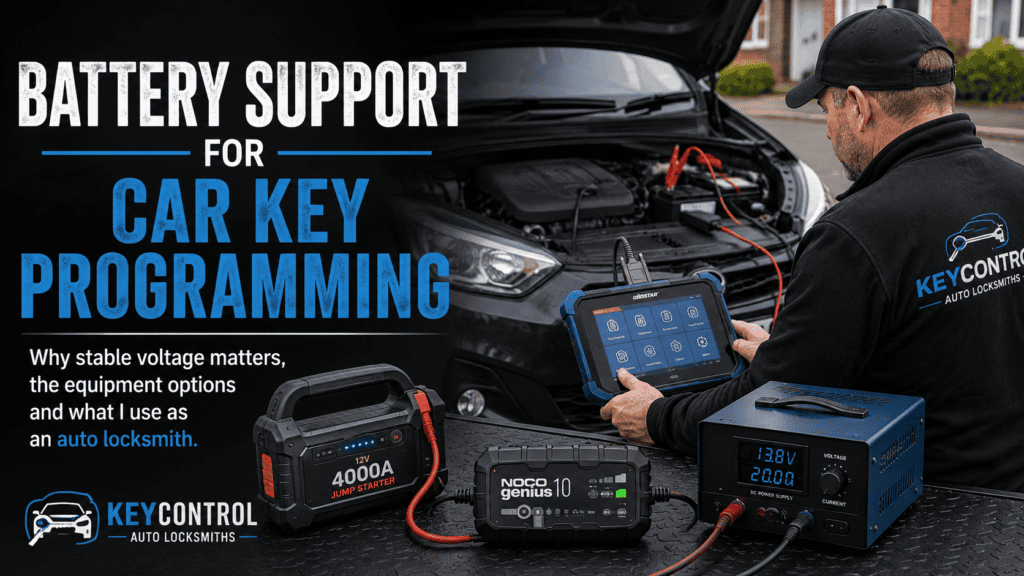
Battery support for car key programming is something that is easily overlooked, but maintaining a stable vehicle voltage can be extremely important while programming keys, immobiliser systems and vehicle control modules. A battery that appears perfectly capable of starting a car can still allow the voltage to fall during a programming procedure.
At KeyControl Auto Locksmiths, I use battery support where appropriate during key programming and other diagnostic work. This isn’t simply about preventing a flat battery. On some vehicles, a significant voltage drop or loss of power while information is being written to a control module can interrupt the procedure and potentially cause much bigger problems.
There is also an important difference between a jump starter, a battery charger and a proper voltage support or stabilisation supply. They may all connect to a vehicle battery, but they are designed to do different jobs.
Why Stable Battery Voltage Matters During Key Programming
Modern vehicle key programming often involves communicating with several electronic control modules. Depending on the vehicle and the procedure being carried out, ignition circuits may need to remain active for an extended period while diagnostic and programming equipment communicates with the immobiliser system.
During that time the vehicle can be consuming considerably more power than you might expect. Interior systems, control modules, instrument displays and other electronics may all be awake even though the engine isn’t running.
If battery voltage falls too far, communication with a module can be interrupted. At best that may mean starting the procedure again. During some programming or module-writing operations, however, losing stable power at the wrong moment can create a much more serious problem.
That’s why I treat battery condition and voltage support as part of preparing the vehicle for the job rather than something to think about only after the battery warning appears.
Battery Support for Car Key Programming: What Are the Options?
There are several ways of providing additional power to a vehicle, but they shouldn’t all be treated as interchangeable. The right equipment depends on whether the aim is simply to start a vehicle, recharge its battery or maintain a stable electrical supply while diagnostic or programming work is taking place.
Jump Starters
A portable jump starter is primarily designed to provide a large amount of current for a short period so that an engine can be started when the vehicle battery is weak or discharged.
I carry jump-starting equipment because it is extremely useful in mobile automotive work, but a jump pack should not automatically be regarded as a substitute for a proper programming power supply. Its main job is delivering starting current, not necessarily maintaining a precisely controlled voltage throughout a lengthy programming operation.
For vehicle owners, however, a good jump starter can be extremely useful emergency equipment, particularly if a vehicle is left unused for periods or suffers from an unexpected flat battery.
Smart Battery Chargers and Maintainers
A smart charger such as the NOCO GENIUS10 is designed to charge and maintain a battery rather than provide the very high short-duration current required for jump starting.
These can be extremely useful for vehicles that spend long periods parked, for maintaining batteries in good condition and for recovering batteries that have become discharged. Some chargers also provide supply modes, although the specifications and limitations of the individual charger need to be understood before using one to support diagnostic or programming work.
Dedicated Voltage Support and Stabilisation
For programming work, the important requirement is often not simply adding charge to the battery but keeping the vehicle’s electrical supply stable while the procedure is taking place.
A suitable support supply or voltage stabiliser is designed for this type of work. The required current capacity depends on the vehicle and the procedure being performed, particularly as modern vehicles can have a substantial electrical load with the ignition switched on.
This is the approach I use when a programming procedure requires battery support. I would rather prepare the power supply before starting than discover halfway through a programming operation that the vehicle battery cannot maintain sufficient voltage.
Jump Starter or Battery Charger – Which Should You Buy?
For most vehicle owners, the choice depends on the problem you’re trying to solve. If you want something to keep in the car for an unexpected flat battery, a portable jump starter makes sense. If the vehicle regularly sits unused or you want to maintain the battery at home, a smart charger is usually the more appropriate tool.
In a workshop or professional environment, I wouldn’t consider either automatically equivalent to a dedicated programming support supply. When carrying out sensitive programming work, the equipment needs to be suitable for maintaining the required voltage and current throughout the procedure.
WOLFBOX 4000A Jump Starter
The WOLFBOX 4000A is the type of portable jump starter I’d consider for emergency starting and general vehicle use. As well as its 12V jump-starting capability, it incorporates a 24,000mAh power bank and USB-C charging, which makes it useful as a general portable power source.
I wouldn’t buy a jump starter specifically as a substitute for a professional programming voltage stabiliser, but as emergency equipment for a vehicle or workshop, this is a useful piece of kit.
NOCO GENIUS10 Smart Battery Charger
The NOCO GENIUS10 takes a different approach. It’s a 10A smart battery charger and maintainer for 6V and 12V batteries, so it’s aimed at charging, maintaining and conditioning batteries rather than providing the short burst of current required to start an engine.
For somebody with a vehicle that spends periods unused, a classic car, motorcycle or simply a battery they want to maintain properly, a smart charger is likely to be more useful than a jump starter for day-to-day battery care.
As an Amazon Associate I earn from qualifying purchases. Affiliate links don’t increase the price you pay.
What I Do Before Starting a Key Programming Job
Before beginning a key programming procedure, I check the condition of the vehicle battery and consider how long the procedure is likely to take. Where battery support is appropriate, I connect it before starting the programming process rather than waiting for the voltage to begin falling.
This became relevant recently while programming a replacement transponder on a 2009 Suzuki Alto. I used voltage support while carrying out the procedure with my OBDSTAR G3. The programmer retrieved the required security information and the replacement key was successfully added to the vehicle.
Not every key programming job requires exactly the same setup. Vehicle design, battery condition and the programming procedure all matter. The important point is to think about power stability before starting work that communicates with or writes information to vehicle control modules.
More Auto Locksmith Tools and Equipment
If you’re interested in the equipment I use professionally, I’ve put together a separate guide to my auto locksmith tools and equipment, including key programmers, diagnostic equipment, electronics tools and other workshop equipment I use or recommend.
Final Thoughts
Battery support for car key programming isn’t simply about preventing a flat battery. It’s about providing a reliable electrical environment while diagnostic and programming equipment communicates with the vehicle.
A jump starter, smart battery charger and dedicated voltage support supply each have different purposes. Understanding those differences helps you choose the right equipment — and, when programming vehicle electronics, reduces the risk of a voltage problem interrupting the job.